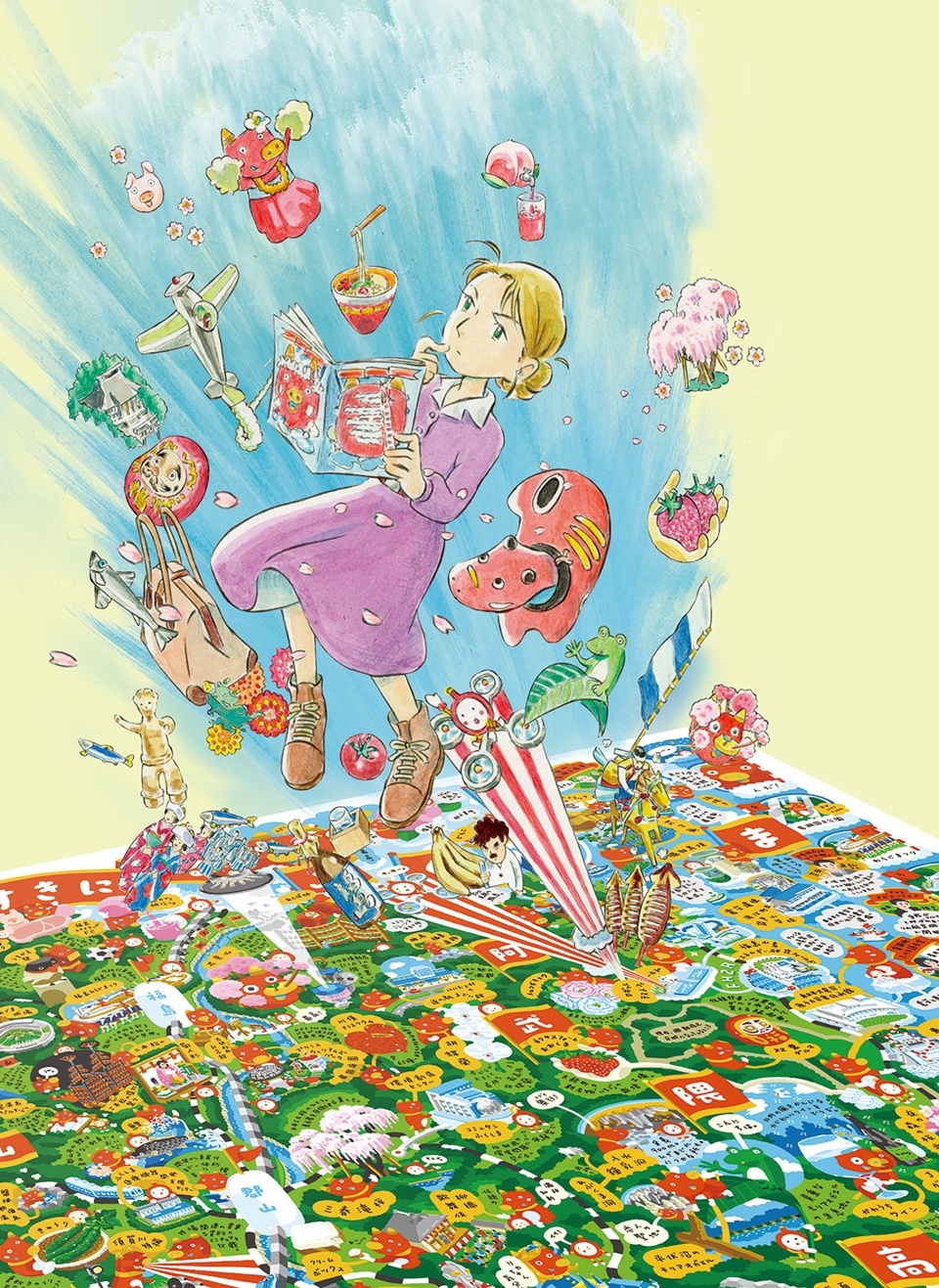
Acclaimed anime director Sunao Katabuchi, the visionary behind the critically acclaimed In This Corner of the World, is bringing his distinctive storytelling approach to a new regional promotional project. According to Anime News Network, Katabuchi has created an original short film titled Fukufuku no Chizu (Map of Fukufuku) for Fukushima Prefecture’s variety magazine Fukushima Map. This intimate animated work represents the second “brand movie” in a cultural initiative designed to showcase the prefecture’s evolving identity and cultural richness to both domestic and international audiences.
The short film tells the story of Sophie, a French philosopher visiting Fukushima Prefecture for the first time to attend a friend’s wedding. When Sophie loses her way in the unfamiliar landscape, a mysterious “friend” and a “map” appear before her, guiding her through unexpected detours and stops throughout the region. As her journey unfolds, Sophie gradually realizes that everything she encounters in Fukushima—from its landscapes to its traditions—represents a “culture” that has been carefully created by someone and passed down through generations. This narrative framework allows Katabuchi to explore themes of cultural preservation, discovery, and the interconnectedness of past and present that have become hallmarks of his directorial work.
A Special Screening Event and Cultural Initiative
The completion of Fukufuku no Chizu will be celebrated with a special “Completion Announcement Event” scheduled for March 5, 2026, at the Forum Fukushima 5 theater. This screening represents more than just a film premiere—it’s part of a broader cultural movement by Fukushima Prefecture to redefine its public image and highlight its cultural assets through the power of animation. The Fukushima Map magazine’s “brand movie” initiative strategically employs acclaimed anime directors to create emotionally resonant short films that communicate the prefecture’s beauty, resilience, and cultural depth in ways that traditional tourism campaigns cannot.
Katabuchi is directing the short film at his studio CONTRAIL, which he founded in 2019, and is also writing the script. In a continuation of his successful creative partnerships, Katabuchi is working again with key staff members from the In This Corner of the World film, including assistant director Chie Uratani. This reunion of talent suggests that Fukufuku no Chizu will carry the same meticulous attention to historical and cultural detail that made In This Corner of the World such a critical and commercial success.
Following in Distinguished Footsteps
Notably, Fukufuku no Chizu is the second entry in the Fukushima Map brand movie series. The first was directed by Kiyotaka Oshiyama, the Fukushima-born director of the internationally acclaimed Look Back anime film. Oshiyama’s short film, titled Aka no Kioku (The Red That Remembers), debuted in March 2025 and set a high standard for the series with its dialogue-free exploration of an animator reflecting on her Fukushima roots. The film featured the traditional Akabeko red cow folk craft and represented Oshiyama’s personal expression of feelings he experienced during and after the Great East Japan Earthquake and tsunami of March 11, 2011.
By selecting two directors with such profound emotional connections to their work—Oshiyama through his Fukushima birthplace and Katabuchi through his dedication to preserving and presenting cultural memory—the Fukushima Map initiative demonstrates a sophisticated understanding of how animation can serve as a bridge between regional identity and global audiences.
Katabuchi’s Distinguished Career and Artistic Vision
Sunao Katabuchi has established himself as one of anime’s most thoughtful and meticulous directors. His 2016 film In This Corner of the World, based on Fumiyo Kōno’s manga, became a cultural phenomenon in Japan, earning numerous accolades including the Japan Academy Prize for Best Animation of the Year. The film was rated 2016’s best Japanese film—animated or live-action—by the prestigious film journal Kinema Junpo, marking the first time since 1988 (when My Neighbor Totoro topped the list) that an anime had received this honor.
The film’s success stemmed from Katabuchi’s extraordinary commitment to historical accuracy and emotional authenticity. He spent six years researching the project, collecting accounts from survivors and gathering photographs to meticulously recreate the cityscapes of pre-war and wartime Kure and Hiroshima. This dedication to detail resulted in a film that presented World War II from the perspective of a young housewife named Suzu, whose daily struggles and quiet resilience resonated deeply with audiences worldwide. The film’s theatrical run lasted an unprecedented 1,133 days across 484 theaters, with total admissions reaching 2.1 million.
An extended version titled In This Corner (and Other Corners) of the World opened in Japan in December 2019, adding additional scenes and depth to Suzu’s story. The success of both versions established Katabuchi as a director capable of finding universal human truths in specific historical moments—a skill that seems ideally suited to the Fukufuku no Chizu project’s goal of revealing Fukushima’s cultural layers through an outsider’s perspective.
A Diverse Directorial Portfolio
While Katabuchi is best known internationally for In This Corner of the World, his directorial career spans diverse genres and styles. Western anime fans may remember him as the director of Black Lagoon, the ultraviolent action series that stands in stark contrast to the gentle humanism of his more recent work. He also directed Black Lagoon: The Second Barrage and Black Lagoon: Roberta’s Blood Trail, demonstrating his versatility across tonal extremes.
His other feature films include Princess Arete (2001), a thoughtful subversion of fairy tale conventions, and Mai Mai Miracle (2009), a nostalgic period piece set in 1955 rural Japan. Interestingly, Katabuchi has noted that his work on Mai Mai Miracle sparked his curiosity about what life was like ten years earlier during wartime Japan, which eventually led him to In This Corner of the World. He also directed Meiken Lassie (Famous Dog Lassie), showcasing his ability to work across different narrative frameworks and audience demographics.
Early in his career, Katabuchi worked at Telecom Animation and Mushi Productions, contributing to projects like Little Nemo: Adventures in Slumberland, and served as assistant director to Hayao Miyazaki on Kiki’s Delivery Service. This experience working alongside one of anime’s greatest masters clearly influenced Katabuchi’s own approach to animation as a medium for exploring human experience with empathy and precision.
The Mourning Children: Katabuchi’s Next Major Project
While Fukufuku no Chizu represents a shorter creative endeavor, Katabuchi’s primary focus remains on his latest feature-length animated film, The Mourning Children: Nagiko and the Girls Wearing Tsurubami Black (Tsurubami-Iro no Nagiko-tachi), which is currently in development. This ambitious project, which Katabuchi began developing in 2017, is set in Kyoto during the 10th century—the Heian period when The Pillow Book was written by the real-life literary figure Sei Shōnagon.
The film challenges the elegant, romanticized image of the Heian period often presented in literature and art by depicting a Kyoto ravaged by repeated epidemics of plague, with tens of thousands dead, gutters filled with corpses, children abandoned in the mountains, and groups of wild dogs watching vigilantly outside the city. A work-in-progress version of the film screened at the prestigious Annecy International Animation Film Festival in April 2025, generating significant international interest.
The Mourning Children features music by Akira Senju (Fullmetal Alchemist: Brotherhood), character design and animation direction by Masashi Andō (co-director of The Deer King), and art direction by Yūji Kaneko (Ranking of Kings, Little Witch Academia). Assistant director Chie Uratani, who is also working on Fukufuku no Chizu, continues her creative partnership with Katabuchi. The film is being produced by MAPPA and CONTRAIL, with Katabuchi handling both direction and screenplay.
Animation as Cultural Bridge
The Fukufuku no Chizu project exemplifies a growing trend of regional governments in Japan commissioning high-quality anime content to promote tourism and cultural awareness. Fukushima Prefecture, still working to rebuild its image following the 2011 Great East Japan Earthquake, tsunami, and Fukushima Daiichi nuclear disaster, has strategically turned to animation—one of Japan’s most powerful cultural exports—to communicate its recovery and ongoing vitality.
By choosing directors like Oshiyama and Katabuchi, who bring both technical excellence and emotional depth to their work, the Fukushima Map initiative avoids the pitfalls of superficial promotional content. Instead, these “brand movies” function as genuine artistic expressions that happen to serve a promotional purpose, making them far more effective at connecting with audiences on an emotional level.
Sophie’s journey as a French philosopher discovering Fukushima’s layered cultural heritage provides an ideal framework for international audiences to experience the prefecture through fresh eyes. The choice of a foreign protagonist acknowledges that much of the intended audience may be unfamiliar with Fukushima beyond headlines about the 2011 disaster, inviting viewers to join Sophie in discovering the prefecture’s beauty, traditions, and resilient spirit.
The Power of Regional Storytelling
Katabuchi’s involvement in Fukufuku no Chizu aligns perfectly with his established interest in how places shape people and how cultures are transmitted across generations. Just as In This Corner of the World revealed the humanity of wartime Hiroshima through Suzu’s daily experiences, this new short promises to reveal Fukushima’s cultural richness through Sophie’s exploratory journey.
The concept of culture as something “created by someone and passed down through generations” resonates with Katabuchi’s broader artistic philosophy. His films consistently explore how individuals navigate larger historical and cultural forces, finding meaning and connection in specific places and moments. Whether depicting wartime Japan, medieval Kyoto, or contemporary Fukushima, Katabuchi’s work emphasizes the importance of understanding and preserving cultural memory while remaining open to new perspectives and interpretations.
As anime continues to evolve as both an art form and a cultural force, projects like Fukufuku no Chizu demonstrate the medium’s unique capacity to communicate complex ideas about place, identity, and cultural continuity in emotionally accessible ways. The March 5 screening event will offer audiences their first opportunity to experience Katabuchi’s vision for Fukushima, adding another chapter to the director’s distinguished career of bringing overlooked stories and places into vivid animated life.
With his characteristic attention to detail and humanistic approach, Katabuchi’s Fukufuku no Chizu promises to be more than just a promotional short—it will likely serve as a thoughtful meditation on discovery, cultural preservation, and the stories that places tell to those willing to listen.